Abstract
Next-generation extended reality (XR) networks rely on mmWave communication to deliver multi-gigabit throughput. However, these highly directional links remain fundamentally fragile to user mobility and environmental blockages, causing frequent outages under traditional reactive beam management. While emerging neural radio fields can explicitly model and predict these propagation paths, prior work remains confined to passive, offline channel reconstruction.
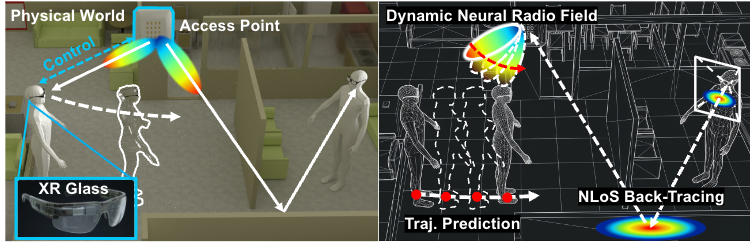
To overcome this gap, we introduce RadioSight: a real-time, multi-modal radio field system that acts as a predictive mmWave optimization engine for proactive Multi-User MIMO (MU-MIMO) beamforming. RadioSight introduces bidirectional beam tracing and real-time semantic object synchronization to anticipate short-term RF geometry changes without full model retraining. This motion-aware design transforms the radio field into an actionable, closed-loop signal for reliable beam decisions under rapid head movement and occlusions.
Implemented as an edge-executable pipeline for commercial 28 GHz arrays, RadioSight updates scene splats in real time and produces sub-millisecond beam predictions without exhaustive codebook sweeps. Extensive experiments demonstrate RadioSight reduces beam-search error by up to 47%, improves median throughput by 2x, and enhances link stability. Our results offer the first demonstration that radio field representations can directly enable predictive, end-to-end mmWave network optimization.
Dataset & Code Release
Multi-Modal Neural Ray Tracing Dataset & Codebase
We will release the complete multi-modal neural ray tracing dataset alongside our full source code, neural radio field training scripts, real-time optimization models, and evaluation benchmarks on commercial 28 GHz phased arrays.
Video Demos
BibTeX
@inproceedings{zhang2026radiosight,
  title={RadioSight: Predictive mmWave XR Network Optimization from Dynamic Neural Radio Fields},
  author={Lihao Zhang and Paul Kudyba and Zhenlin An and Haijian Sun},
  booktitle={Proceedings of the 32th Annual International Conference on Mobile Computing and Networking},
  series={MobiCom '26},
  year={2026},
  publisher={ACM}
}